White Label Mobile Apps in 2026: How They Work, Benefits, and What Businesses Should Know

June 15, 2026

Table of contents

A few years ago, having a mobile app felt like something only large companies could afford to do properly. Businesses either spent huge budgets on custom development or settled for relying entirely on third-party platforms that controlled the customer relationship.

That has changed very quickly.

Today, restaurants, retail brands, fitness businesses, salons, and franchises are launching branded apps much faster through white label platforms that already provide the technical infrastructure behind the scenes. The business focuses on branding, operations, and customer experience while the provider manages the software foundation itself.

This shift is happening alongside growing mobile-first consumer behavior. According to Statista, global mobile app revenue is projected to surpass $613 billion in 2026, showing how deeply app-based experiences now influence how customers order, shop, book, and interact with brands.

In this blog, we’ll break down what white label mobile apps are, how they work, how they compare with custom-built apps, the biggest advantages and limitations, what features businesses should look for, and how restaurants and growing brands are using them to build stronger direct customer relationships in 2026.

Key Takeaways

  • White label mobile apps allow businesses to launch fully branded apps much faster and at a significantly lower cost than building custom software from scratch.
  • Most white label app providers handle backend infrastructure, security updates, maintenance, and operating system compatibility, reducing technical burden for businesses.
  • Restaurants, franchises, e-commerce brands, and service businesses increasingly use white label apps to create direct customer relationships without relying entirely on third-party platforms.
  • The strongest white label apps combine branding flexibility with operational tools like payments, loyalty programs, analytics, ordering systems, and multi-location management.
  • Businesses should evaluate customization flexibility, integrations, scalability, App Store publishing support, and provider reliability before choosing a white label mobile app platform.

What Is a White Label Mobile App?

A white label mobile app is a pre-built application developed by a third-party software provider that businesses can rebrand and launch as their own product. Instead of building an app completely from scratch, businesses customize the existing platform with their own branding, logo, colors, content, and customer experience.

To users, the app appears fully owned and operated by the business itself.

Most white label apps are published under the business’s own Apple App Store and Google Play Store developer accounts, allowing companies to maintain their brand identity while avoiding the time, cost, and technical complexity of custom mobile app development.

White label mobile apps are commonly used across:

  • restaurants and food delivery businesses
  • e-commerce brands
  • fitness and wellness platforms
  • salons and booking businesses
  • loyalty and rewards programs
  • franchises and multi-location operations
  • creator communities and membership platforms

The biggest advantage is speed. Businesses can often launch a fully functional branded app in weeks instead of spending months or years building custom software infrastructure internally.

Most white label app providers also handle:

  • backend infrastructure
  • software maintenance
  • operating system compatibility
  • bug fixes
  • security updates
  • ongoing platform improvements

This allows businesses to focus more on customer experience, marketing, operations, and growth instead of software development management.

Also read: Multi-Location Menu Sync: A 2026 Guide to Scalable Restaurant Menu Operations

For restaurants specifically, white label apps have become increasingly popular because they help brands create direct customer ordering channels without depending entirely on third-party delivery marketplaces.

Stop losing 20-30% of every order to third-party apps

The Restaurant Margin Playbook shows you how to build a direct ordering channel, own your customer relationships, and reclaim the margins delivery platforms are quietly taking.

Download the eBook →

How White Label Apps Differ from Custom Mobile Apps?

Although white label apps and custom mobile apps may look similar from a customer perspective, the way they are developed, managed, and scaled is very different behind the scenes.

White Label Mobile Apps vs Custom Mobile Apps
White Label Mobile Apps Custom Mobile Apps
Built from an existing pre-developed platform. Built entirely from scratch for one business.
Faster launch timelines, often within days or weeks. Development may take several months or longer.
Lower upfront development costs. Significantly higher development investment.
Core maintenance and updates are handled by the provider. The business manages ongoing maintenance directly or through developers.
Businesses customize branding, workflows, and operational settings within the platform’s structure. Businesses have full control over app architecture, features, and functionality.
Easier for businesses without internal technical teams. Usually requires dedicated development resources or technical partners.
Feature flexibility depends on the provider’s roadmap and system limitations. Features can be fully customized based on business requirements.
Updates for operating systems and security are typically managed centrally. Businesses must manage app compatibility, updates, and infrastructure independently.
Ideal for businesses prioritizing speed, operational simplicity, and lower risk. Ideal for businesses requiring highly unique functionality or proprietary systems.
Ongoing subscription or licensing dependency on the provider usually exists. Greater ownership and long-term control over the software ecosystem.

For many businesses, especially restaurants and multi-location operators, the decision often comes down to balancing speed, cost, operational simplicity, and customization needs.

How White Label Mobile Apps Work

This model exists because building a native mobile app from scratch is expensive, slow, and technically demanding. A custom build for a restaurant app can run anywhere from $50,000 to $200,000+ and take six to eighteen months before it's ready for customers. A white label solution gets you to the same customer-facing outcome in weeks, at a fraction of the cost, without needing a development team on payroll.
How White Label Mobile Apps Work

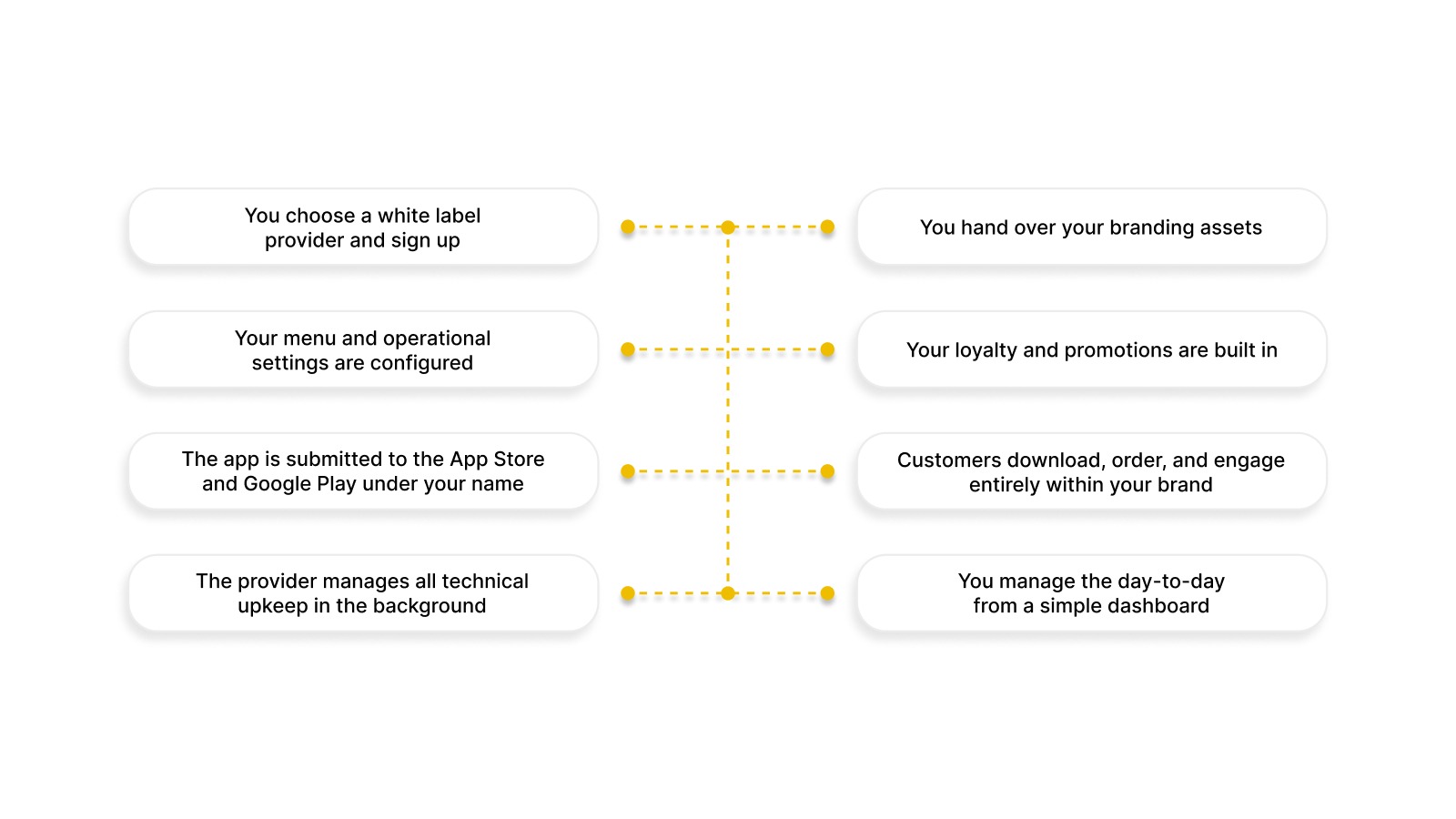
Here is how the process works from start to finish:

1. You choose a white label provider and sign up: You select a provider whose platform covers the features your restaurant needs, online ordering, loyalty, push notifications, QR ordering, or whatever combination matters most to your operation. Most providers offer a demo or trial period before you commit.

2. You hand over your branding assets: Your logo, brand colours, fonts, and any photography go to the provider's onboarding team. This is the layer that makes the app look like yours. Some providers handle the full design configuration for you. Others give you a dashboard to upload and adjust these yourself.

3. Your menu and operational settings are configured: Every item, category, modifier, price, and description gets loaded into the platform. You also set up your ordering rules at this stage; pickup vs delivery, delivery zones, minimum order values, scheduling windows, and any location-specific settings if you run multiple sites.

4. Your loyalty and promotions are built in: If the platform includes loyalty, you configure the structure here, how points are earned, what rewards unlock at which thresholds, whether you want streak-based challenges or milestone rewards. Promo codes, discount rules, and any automated campaigns are also set up during this stage.

5. The app is submitted to the App Store and Google Play under your name: The provider handles the technical submission process. The app goes live, listed as your product, with your branding, your name, and your App Store description. Customers searching for your restaurant find and download it as if your team built it.

6. Customers download, order, and engage entirely within your brand: From the customer's side, the experience is seamless and fully branded. They create an account, browse your menu, place orders, earn loyalty points, and receive push notifications. They have no visibility into the provider's platform running underneath.

7. The provider manages all technical upkeep in the background: Security patches, feature updates, performance improvements, and App Store compliance changes are handled entirely by the provider. You don't need a developer on call. When the platform improves, your app improves with it automatically.

8. You manage the day-to-day from a simple dashboard: Menu changes, new promotions, push notification campaigns, and loyalty adjustments all happen through an operator dashboard. Most providers build this to be manageable by anyone on your team without technical knowledge.

Also read: Multi-Franchise Management for Efficient Restaurant Scaling in 2026

What You Can and Can't Customize in a White Label App?

Not everything in a white label app is open for modification. Providers maintain control over the core architecture and certain functional elements to keep the platform stable, secure, and scalable across all their restaurant clients. Here's a clear breakdown of where your freedom starts and where it ends:

White Label App Customization Table
Area What You Can Customize What's Fixed by the Provider
Branding Logo, brand colours, typography, app name, splash screen, icon Core app architecture and UI framework
Menu All items, descriptions, photos, pricing, categories, modifiers How menu data is structured and stored
Ordering Flow Pickup vs delivery options, order scheduling, special instructions Checkout logic, payment processing security layer
Loyalty & Rewards Points structure, reward thresholds, streak rules, milestone triggers Loyalty engine and points calculation backend
Push Notifications Message content, timing, audience segments, promotional campaigns Notification delivery infrastructure
Promotions Discount types, promo codes, limited-time offers, spin-to-win rewards How promotions are validated and applied at checkout
Delivery Settings Delivery zones, minimum order values, delivery fees Third-party delivery API integrations
App Store Listing App name, description, screenshots, category App Store and Google Play compliance requirements
Customer Data Access to your customer profiles, order history, and behavior data How data is stored, encrypted, and protected
Integrations POS systems, payment gateways, and loyalty platforms supported by the provider Which third-party integrations are available on the platform

Also read: Restaurant Automation Software: Top 6 Tools To Protect Your Margins

The practical takeaway is that everything a customer sees and experiences is yours to shape. The underlying engine that makes it run reliably and securely is not. For most restaurants, that's a straightforward trade: full brand ownership without the technical burden of maintaining the infrastructure behind it.

Benefits of White Label Mobile App Development

Businesses are increasingly choosing white label mobile apps because they offer a faster and more practical way to launch branded digital experiences without building complex software infrastructure from scratch.
Benefits of White Label Mobile App Development

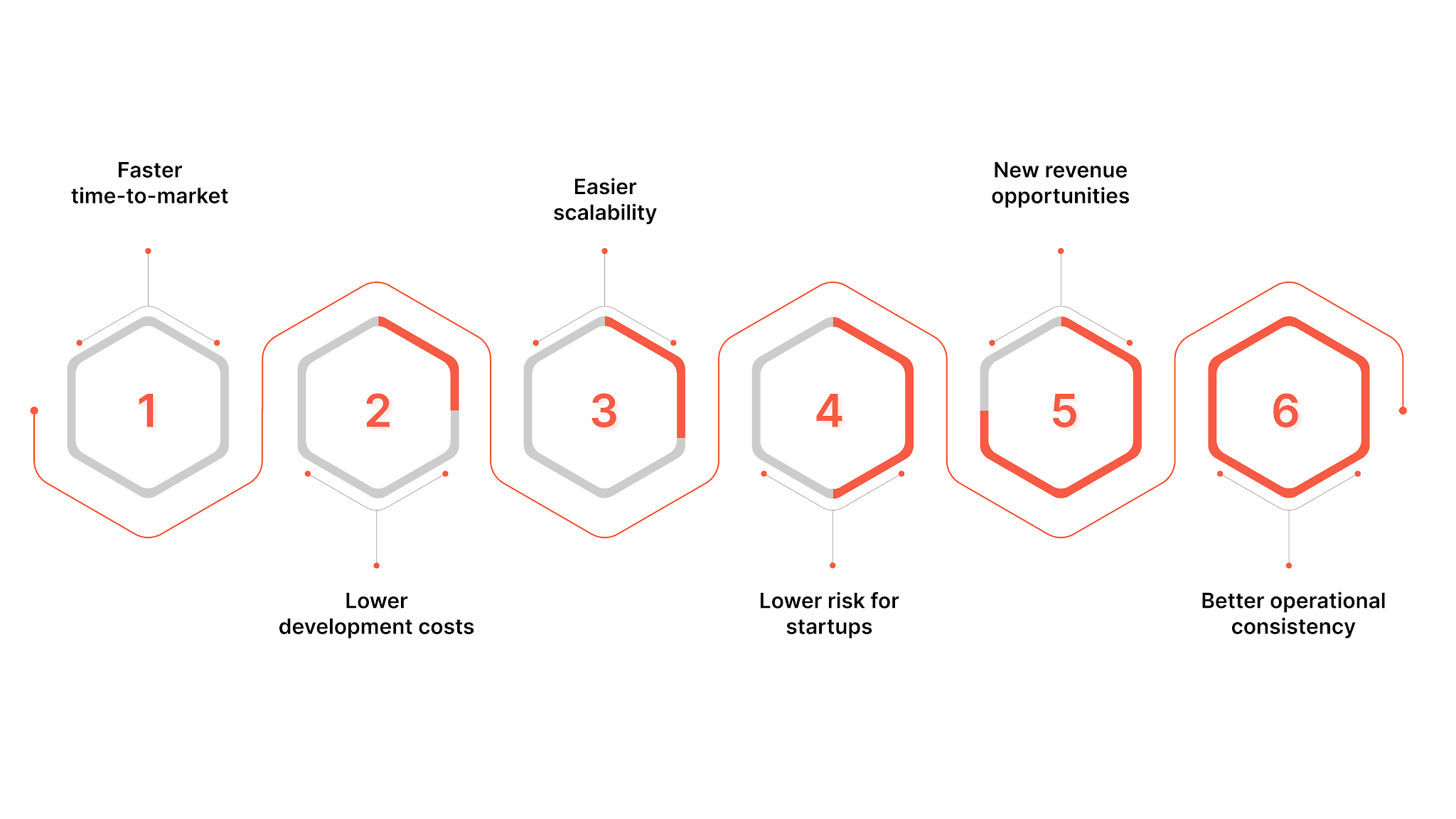
Here are the biggest advantages driving white label app adoption in 2026.

  • Faster time-to-market: Custom mobile apps often take several months to develop, test, and launch properly. White label apps significantly reduce deployment time because the core infrastructure already exists, allowing businesses to go live much faster.
  • Lower development costs: Businesses avoid many of the heavy expenses tied to custom software development, including backend engineering, infrastructure setup, testing, security architecture, and ongoing technical maintenance.
  • Easier scalability: Most white label platforms are already designed to support large traffic volumes, growing customer bases, and multi-location operations, making it easier for businesses to scale without rebuilding systems constantly.
  • Lower risk for startups: Startups can launch apps, validate customer demand, and scale gradually without committing massive budgets upfront to fully custom software development.
  • New revenue opportunities for agencies: Agencies often resell white label apps under their own branding, allowing them to offer app-based services without building large in-house engineering teams.
  • Better operational consistency for franchises and multi-location businesses: Centralized app infrastructure helps businesses maintain consistent branding, loyalty programs, ordering workflows, and customer experiences across locations.

How to Make Your White Label App Feel Unique and Brand-Original

One of the biggest concerns businesses have with white label mobile apps is whether the app will feel too generic or look identical to other apps using the same platform.

That concern has become even more important because both Apple App Store and Google Play policies increasingly discourage low-quality duplicate apps that provide little differentiation or customer value.

Here are some of the most effective ways businesses can make a white label app feel more original and platform-compliant.

  • Customize the customer experience beyond branding: Simply changing the logo and colors is rarely enough anymore. Businesses should personalize navigation flows, onboarding experiences, promotions, loyalty structures, and operational workflows to make the app feel brand-specific.
  • Build unique operational functionality around your business model: Restaurants, fitness brands, retail stores, and franchises all operate differently. The app should reflect those operational differences through ordering flows, membership systems, booking experiences, or delivery logic tailored to the business.
  • Use original content, visuals, and messaging throughout the app: App descriptions, banners, product imagery, notifications, menus, onboarding screens, and customer communication should all carry the business’s own voice and branding instead of relying heavily on default templates.
  • Integrate brand-specific loyalty and engagement systems: Personalized rewards, customer tiers, referral systems, push campaigns, and retention workflows help create a more unique customer ecosystem that separates the app from generic marketplace experiences.
  • Continuously evolve the app experience over time: Businesses that actively update promotions, workflows, seasonal campaigns, layouts, and customer experiences create apps that feel more dynamic and brand-driven rather than static white label clones.
  • Avoid publishing multiple nearly identical apps across brands: App stores increasingly monitor repetitive app structures and duplicated experiences. Businesses should ensure each app serves a genuinely distinct customer audience and operational purpose.
  • Focus on solving a real operational or customer problem: The strongest white label apps succeed because they improve convenience, simplify ordering, strengthen loyalty, or create a smoother customer experience, not simply because the business “has an app.”
  • Choose providers that allow deeper customization flexibility: Some white label platforms only offer surface-level branding changes, while others support more meaningful operational customization that helps businesses create stronger differentiation.

Also read: 7 Ways AI-Powered Restaurant Technology Boosts F&B Profit (2026)

For restaurants especially, originality often comes less from visual design alone and more from how smoothly the app supports ordering, payments, loyalty, delivery, customer communication, and operational consistency across every touchpoint.

What to Look for in a High-Quality White Label Mobile App

Not all white label mobile apps offer the same level of flexibility, scalability, or operational reliability. Some platforms simply provide basic branding options, while others function as fully connected business ecosystems that support payments, customer engagement, analytics, loyalty, and multi-location operations.

Before choosing a white label app provider, businesses should evaluate whether the platform can support both current operational needs and long-term growth.

Here are the most important features businesses should look for.

  • Strong branding customization: The app should allow businesses to fully customize logos, colors, fonts, layouts, and customer-facing experiences so the app feels native to the brand.
  • App Store and Google Play publishing support: A quality provider should help businesses launch under their own developer accounts instead of publishing under a shared marketplace identity.
  • Scalable infrastructure: The platform should support growing customer traffic, higher transaction volumes, additional locations, and expanding operational complexity without performance issues.
  • POS and third-party integrations: Restaurants and operational businesses need smooth integrations with POS systems, payment gateways, loyalty systems, delivery platforms, and reporting tools.
  • Push notifications and customer engagement tools: Built-in communication tools help businesses drive repeat orders, promotions, loyalty campaigns, and customer retention directly through the app.
  • Real-time analytics and reporting: Businesses should have visibility into customer behavior, sales trends, order performance, retention metrics, and operational activity from one centralized dashboard.
  • Flexible payment support: The app should support digital wallets, online payments, contactless payments, and multiple checkout methods without creating friction for customers.
  • Loyalty and rewards capabilities: Integrated loyalty systems help businesses increase repeat purchases and build stronger direct customer relationships over time.
  • Multi-location management tools: Franchise and multi-location businesses need centralized control over menus, promotions, reporting, pricing, and operational workflows across all stores.
  • Reliable maintenance and support: Providers should actively handle software updates, bug fixes, operating system compatibility, and technical support to reduce operational downtime.
  • Security and compliance standards: The platform should maintain secure payment infrastructure, encrypted customer data handling, and compliance with industry standards like PCI DSS.
  • Operational flexibility: Businesses should be able to adapt menus, workflows, delivery settings, campaigns, and customer experiences without requiring constant developer involvement.

For restaurants specifically, the strongest white label mobile apps are the ones that connect ordering, payments, loyalty, delivery, and customer engagement into one consistent operational system instead of treating each function separately.

If your restaurant wants a fully branded mobile ordering and delivery experience without building an app from scratch, iOrders helps simplify the entire process. Our white label delivery app allows restaurants to launch their own branded ordering platform with integrated payments, QR ordering, loyalty features, delivery coordination, and multi-location management, all while keeping direct control over customer relationships and revenue.

Instead of sending customers back to third-party marketplaces, restaurants can create a direct ordering experience that feels fully their own.

Book a demo with iOrders’ white label delivery app and see how it fits into your restaurant workflow.

FAQs

1. How long does it usually take to launch a white label mobile app?

Most white label mobile apps can be launched within a few weeks depending on branding setup, integrations, and App Store approval timelines.

2. Do businesses own their customer data in a white label app?

In most cases, businesses maintain access to their customer profiles, ordering data, and engagement insights, although data infrastructure is still managed by the provider.

3. Do white label apps support push notifications and customer marketing?

Yes, most modern white label apps include push notifications, loyalty campaigns, promotional messaging, and customer engagement tools built into the platform.

4. Can businesses switch providers later if needed?

Yes, but migration complexity depends heavily on the platform structure, data portability, integrations, and how much the business relies on provider-specific infrastructure.

5. Can white label apps integrate with restaurant POS systems?

Yes, many restaurant-focused white label platforms integrate directly with POS systems, payment gateways, loyalty platforms, and online ordering infrastructure.

Related Blogs

Maximize Your Restaurant Profits

Download a FREE Restaurant Margin Playbook
By providing a telephone number and submitting this form you are consenting to be contacted by SMS text message. Message & data rates may apply. You can reply STOP to opt-out of further messaging. Reply Help for more information. Message frequency may vary.
Thank you! Your PDF is ready.
Download
Oops! Something went wrong while submitting the form.