A few years ago, restaurants treated contactless payments like an “extra” feature. Today, customers notice immediately when tap-to-pay does not work. For restaurants, this shift has quietly changed how front-of-house operations, ordering flow, and customer expectations work day to day.
According to Payments Canada, contactless payments accounted for 58% of total payment volume in 2024, with more than 13 billion contactless transactions processed across the country.
They now influence checkout speed, table turnover, QR ordering experiences, delivery workflows, customer expectations, and how smoothly operations run during peak hours.
In this blog, we’ll break down how contactless payment systems actually work, the technologies behind them, the different payment methods customers use today, security considerations, operational challenges, and how restaurants can build smoother digital payment experiences in 2026.
Key Takeaways
Contactless payment systems allow customers to complete transactions quickly using tap-enabled cards, smartphones, smartwatches, and mobile wallets through NFC technology.
Restaurants increasingly use contactless payments alongside QR ordering, kiosks, online ordering, and digital loyalty systems to create faster and smoother customer experiences.
Modern contactless payments use strong security technologies like tokenization, encryption, EMV chip standards, and dynamic transaction codes to reduce fraud risks.
The biggest operational challenge for businesses is not enabling tap payments themselves, but keeping payment systems integrated consistently across POS, ordering, delivery, and reporting workflows.
Contactless payments have shifted from being a convenience feature to becoming a standard customer expectation across restaurants and hospitality businesses in 2026.
What Is a Contactless Payment System?
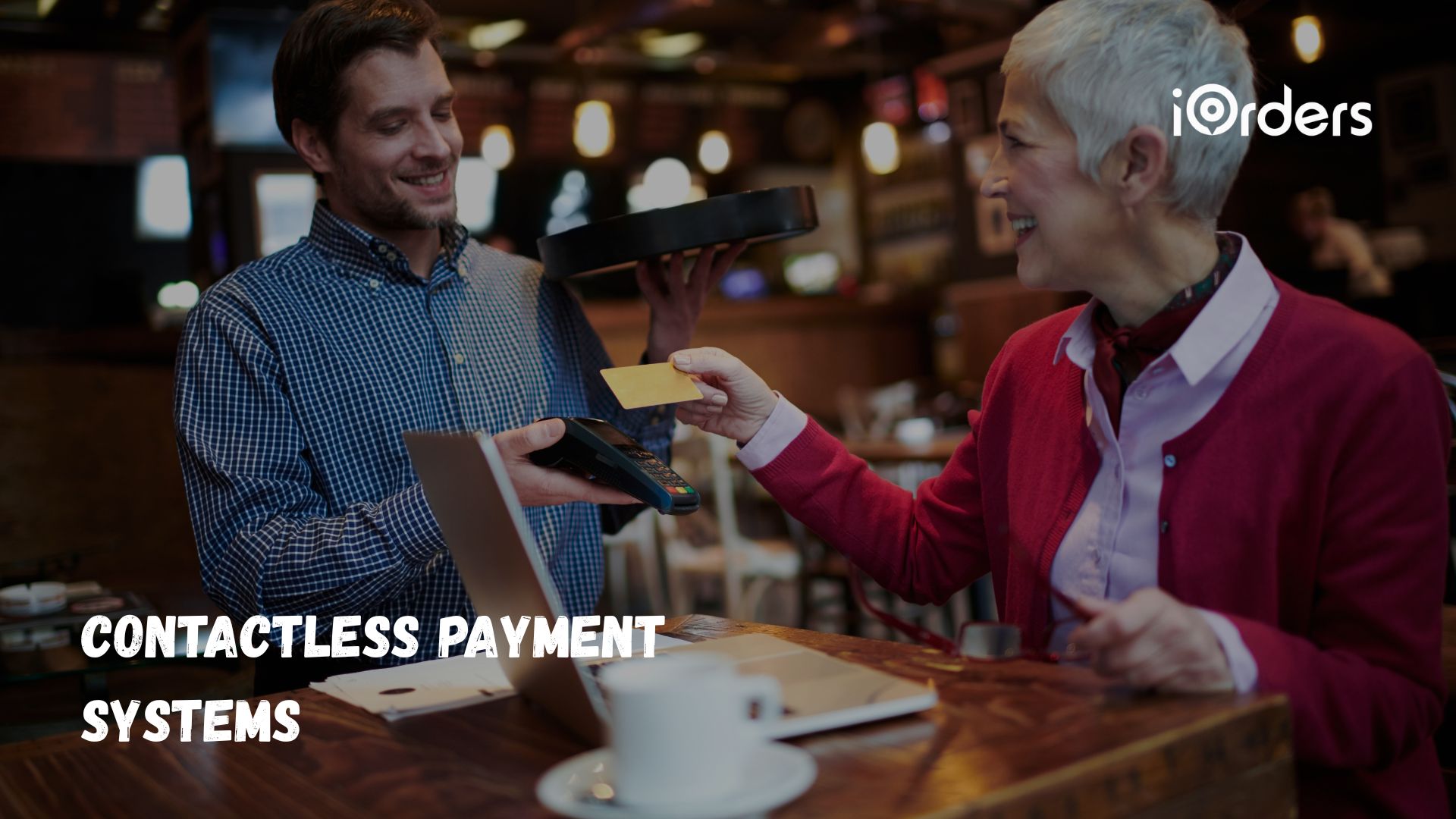
Contactless payment allows customers to pay for products or services by simply tapping a debit card, credit card, smartphone, or wearable device near a compatible payment terminal. Instead of swiping a card, entering a PIN, or signing receipts for smaller transactions, these systems use short-range wireless communication technology, primarily Near Field Communication (NFC), to securely transmit payment information within seconds.
Businesses that support contactless payments use payment terminals marked with the universal contactless symbol, which resembles a sideways Wi-Fi icon.
Today, contactless payments commonly include:
tap-to-pay credit and debit cards
Apple Pay
Google Pay
Samsung Wallet
smartwatches and wearable payments
QR-based mobile payments
mobile wallet apps
Once the device is tapped near the terminal, the payment information is encrypted, verified through the payment processor and bank, and approved almost instantly.
For restaurants and food businesses, contactless payments have become deeply connected to:
Instead of treating payments as a separate final step, many restaurants now integrate contactless payments directly into the overall ordering experience to reduce friction and improve operational flow during busy service periods.
How Contactless Payments Became Mainstream
Although contactless payment technology has existed for years, adoption accelerated rapidly over the last decade, especially after major shifts in customer behavior, mobile wallet adoption, and digital ordering growth.
Several factors pushed contactless payments into the mainstream.
COVID-19 accelerated touch-free payment behavior: During and after the pandemic, businesses and customers prioritized faster, lower-contact checkout experiences, which dramatically increased tap-to-pay adoption across restaurants, retail, and hospitality.
Mobile wallets became widely adopted: Apple Pay, Google Pay, and wearable payment systems normalized phone-based transactions for everyday purchases.
Restaurants needed faster service flow: High-volume restaurants, cafés, and QSR chains increasingly adopted contactless systems to reduce queues, speed up checkout, and improve order throughput during peak hours.
Contactless cards became standard: Most banks now issue NFC-enabled debit and credit cards by default, making tap payments accessible to a much larger customer base.
Digital ordering ecosystems expanded: QR ordering, self-service kiosks, mobile ordering apps, and online payments all helped customers become more comfortable with digital-first transactions.
Payment terminals evolved quickly: Modern POS systems increasingly include built-in NFC readers, mobile wallet compatibility, and integrated contactless payment support as standard features.
In 2026, contactless payments are no longer viewed as a convenience feature alone. For many restaurants and businesses, they have become a basic operational expectation customers assume will already be available.
As adoption increased across restaurants and retail environments, businesses also started weighing the operational advantages and limitations more seriously.
Stop losing 20-30% of every order to third-party apps
The Restaurant Margin Playbook shows you how to build a direct ordering channel, own your customer relationships, and reclaim the margins delivery platforms are quietly taking.
Contactless payments have become one of the most widely adopted payment methods across restaurants, cafés, retail stores, and hospitality businesses because they simplify checkout and improve customer convenience.
At the same time, businesses still need to understand the operational limitations and infrastructure requirements that come with implementing contactless payment systems properly.
Contactless Payments Pros and Cons Table
Pros
Cons
Faster checkout speeds help reduce queues and improve customer flow during busy service periods.
Businesses may need to upgrade older POS systems or payment terminals to support NFC-enabled transactions properly.
Customers can pay quickly without inserting cards, entering PINs for smaller transactions, or handling cash.
Contactless systems rely heavily on stable internet connectivity, payment processors, and functioning hardware.
Restaurants can improve table turnover and front-counter efficiency during peak hours.
Some customers still prefer traditional chip-and-PIN or cash payments over digital tap-based methods.
Mobile wallets like Apple Pay and Google Pay integrate smoothly into the payment experience.
Older software systems may create integration or synchronization issues with reporting and order management.
Reduced physical contact creates cleaner and more convenient checkout experiences.
Some consumers still have concerns around digital payment security and unauthorized scanning myths.
Businesses spend less time handling cash, manual reconciliation, and physical payment processing tasks.
Certain banks and regions still apply transaction limits before requiring PIN verification.
Contactless systems work well alongside QR ordering, kiosks, and self-service payment environments.
Chargebacks, payment disputes, and digital fraud risks still exist despite stronger security protections.
Integrated digital payments create smoother loyalty, tipping, and customer ordering workflows.
Businesses must maintain software updates, PCI compliance, and payment security standards continuously.
For most restaurants and food businesses, contactless payments have shifted from being a convenience feature to becoming a standard customer expectation. The biggest operational advantage comes when payment systems integrate smoothly with ordering, POS, delivery, and customer management workflows instead of operating as disconnected tools.
To understand why contactless payments have become so widely adopted, it’s important to look at the technology powering each transaction behind the scenes.
How Contactless Payment Systems Work
Contactless payment systems work through short-range wireless communication between a payment device and a compatible payment terminal. Although the transaction feels almost instant to the customer, several technologies and financial systems work together behind the scenes to securely authorize the payment.
The process is designed to reduce friction during checkout while maintaining strong payment security standards across restaurants, retail stores, transit systems, kiosks, and online-connected ordering environments.
The Core Technologies Behind Contactless Payments
Modern contactless payments rely on multiple technologies working together to transmit, encrypt, verify, and approve payment information securely.
Contactless Payment Technologies Table
Technology
What It Does
Where It’s Used
NFC (Near Field Communication)
Enables short-range wireless communication between the payment device and terminal during a tap transaction.
Tap-to-pay cards, Apple Pay, Google Pay, smartwatches, payment terminals
RFID (Radio Frequency Identification)
Uses radio waves to identify and transmit data between devices without physical contact. NFC is considered a more secure subset of RFID technology.
Contactless cards, transit cards, access systems
Tokenization
Replaces actual card details with encrypted digital tokens during transactions to protect sensitive payment information.
Mobile wallets, digital payments, online transactions
EMV Chip Technology
Generates dynamic, one-time transaction codes that help reduce card fraud and cloning risks.
Chip cards, tap-enabled debit and credit cards
Payment Gateways and Processors
Verify, route, and authorize the transaction between banks, card networks, and merchant systems.
Mobile wallets like Apple Pay and Google Pay add another security layer through tokenization. Instead of transmitting the customer’s real card number directly, the system sends a unique encrypted token that cannot easily be reused if intercepted.
What Happens During a Contactless Transaction?
Although a contactless payment takes only a few seconds, several systems communicate with each other behind the scenes before the transaction is approved.
Here’s how a typical contactless payment transaction works step by step:
The customer taps a card or mobile device near the payment terminal: The payment terminal detects the NFC-enabled card, smartphone, or wearable device placed within close range.
NFC communication activates automatically: The terminal and payment device establish a short-range encrypted wireless connection to begin the transaction securely.
Encrypted payment data or token is transmitted: Instead of exposing sensitive card details directly, the system often sends encrypted payment credentials or tokenized transaction information.
The payment processor receives the transaction request: The processor routes the payment information through the card network to the customer’s issuing bank for verification.
The issuing bank verifies and authorizes the transaction: The bank checks available funds, fraud signals, card validity, and security credentials before approving or declining the transaction.
The approval response returns to the terminal: Once approved, the terminal displays confirmation, completes the transaction, and the payment is recorded inside the merchant’s POS or payment system.
For restaurants, this entire process increasingly connects directly with:
POS systems
QR ordering workflows
loyalty programs
kitchen display systems (KDS)
online ordering platforms
digital receipts and tipping systems
That operational integration is one of the main reasons contactless payments have become such an important part of modern restaurant infrastructure.
Because transactions happen so quickly, many businesses and customers naturally question how secure the system actually is. Let's learn that in detail.
Are Contactless Payments Safe?
Contactless payments are generally considered highly secure because modern payment systems use multiple layers of encryption, tokenization, and authentication to protect customer payment information during transactions.
In many cases, contactless payments are actually safer than older magnetic stripe card systems because the real card details are rarely transmitted directly during checkout.
Still, businesses need secure infrastructure, updated systems, and strong operational practices to maintain payment security properly across all ordering channels.
The Security Technologies Behind Contactless Payments
Several technologies work together behind the scenes to keep contactless transactions secure.
Tokenization replaces sensitive card information with temporary encrypted digital tokens, reducing the risk of exposing actual card numbers during transactions.
Encryption protects payment information while it travels between the customer’s device, payment terminal, processor, and bank systems.
EMV chip standards add stronger transaction authentication compared to older magnetic stripe systems commonly associated with card fraud.
Dynamic transaction codes generate unique one-time transaction credentials for every payment, making stolen payment data far less useful to attackers.
Mobile wallets like Apple Pay and Google Pay add extra security through fingerprint scans, facial recognition, passcodes, and device-level authentication.
NFC technology only works within a very short physical range, which reduces the chances of unauthorized interception during transactions.
Because of these layered protections, modern contactless payment systems are designed to minimize fraud risk while maintaining fast and convenient checkout experiences.
Best Security Practices for Businesses
Even with strong built-in payment security, businesses still need proper operational safeguards to reduce payment risks effectively.
Maintain PCI compliance to help protect customer payment information and meet industry security standards.
Use secure and regularly updated POS systems to reduce vulnerabilities and improve payment reliability.
Monitor transactions actively for suspicious activity, unusual behavior, or potential fraud attempts.
Keep payment terminals, software, and integrations updated with the latest security patches and system improvements.
Train employees on payment security procedures, fraud awareness, and proper payment handling practices.
Avoid storing unnecessary customer payment information whenever possible.
Use secure business networks instead of unsecured public Wi-Fi connections for payment systems.
Work with payment providers that support strong encryption, tokenization, fraud prevention, and compliance standards.
As contactless payments continue becoming standard across restaurants and hospitality businesses, payment security increasingly depends on how well the entire payment ecosystem works together behind the scenes.
Challenges Businesses Face When Implementing Contactless Payments
Although contactless payments improve speed and customer convenience, businesses still face several operational and technical challenges during implementation.
Hardware upgrade costs can become expensive if older payment terminals do not support NFC-based tap payments.
Outdated POS systems may struggle to integrate properly with mobile wallets, QR ordering systems, or newer payment workflows.
Staff training is still important because employees need to understand how to troubleshoot terminals and assist customers when issues occur.
Internet reliability directly affects payment approval speed and transaction stability during busy service periods.
Some payment processors and gateways may not support every contactless payment method equally across devices or platforms.
Certain customer groups may still prefer traditional chip-and-PIN or cash payments instead of digital tap-based transactions.
Businesses handling payments across POS systems, online ordering, kiosks, and delivery channels may face reconciliation and reporting complexity.
Maintaining consistency across dine-in, takeaway, QR ordering, apps, and delivery systems becomes harder when payment infrastructure is fragmented.
As restaurants continue expanding digital ordering and contactless payment experiences, the biggest operational challenge is rarely the payment itself. It is keeping every ordering and payment touchpoint connected behind the scenes.
That’s where iOrders helps simplify operations.
Instead of managing disconnected systems for QR ordering, online payments, takeaway, delivery, loyalty programs, and dine-in ordering separately, iOrders helps restaurants bring those workflows together into one connected ecosystem built specifically for food businesses.
create smoother digital ordering journeys without relying entirely on third-party platforms
For restaurants adopting contactless payments in 2026, the real advantage comes from operational consistency, not just faster transactions. iOrders helps restaurants build that consistency across every customer touchpoint.
If you want faster, cleaner, and more connected payment experiences across your restaurant operations, book a demo with iOrders and explore how it fits into your workflow.
FAQs
1. Do contactless payments work without internet?
Some payment terminals can temporarily store transactions offline, but most contactless payments still require internet connectivity for real-time authorization and processing.
2. Can customers use contactless payments for large transactions?
Yes, although some banks or payment providers may require PIN verification for higher-value transactions depending on regional security limits.
3. Can contactless payments reduce restaurant wait times?
Yes, faster tap-to-pay transactions help reduce queues, improve checkout flow, and increase operational speed during busy service periods.
4. Can restaurants combine QR ordering with contactless payments?
Yes, many restaurants now integrate QR ordering and contactless payments into the same digital ordering flow for faster and more convenient customer experiences.
5. What happens if a contactless payment fails?
If a transaction fails, customers can usually retry the tap, use chip-and-PIN payment, switch payment methods, or complete the transaction manually depending on the terminal setup.


.png)


.webp)