March 13, 2026
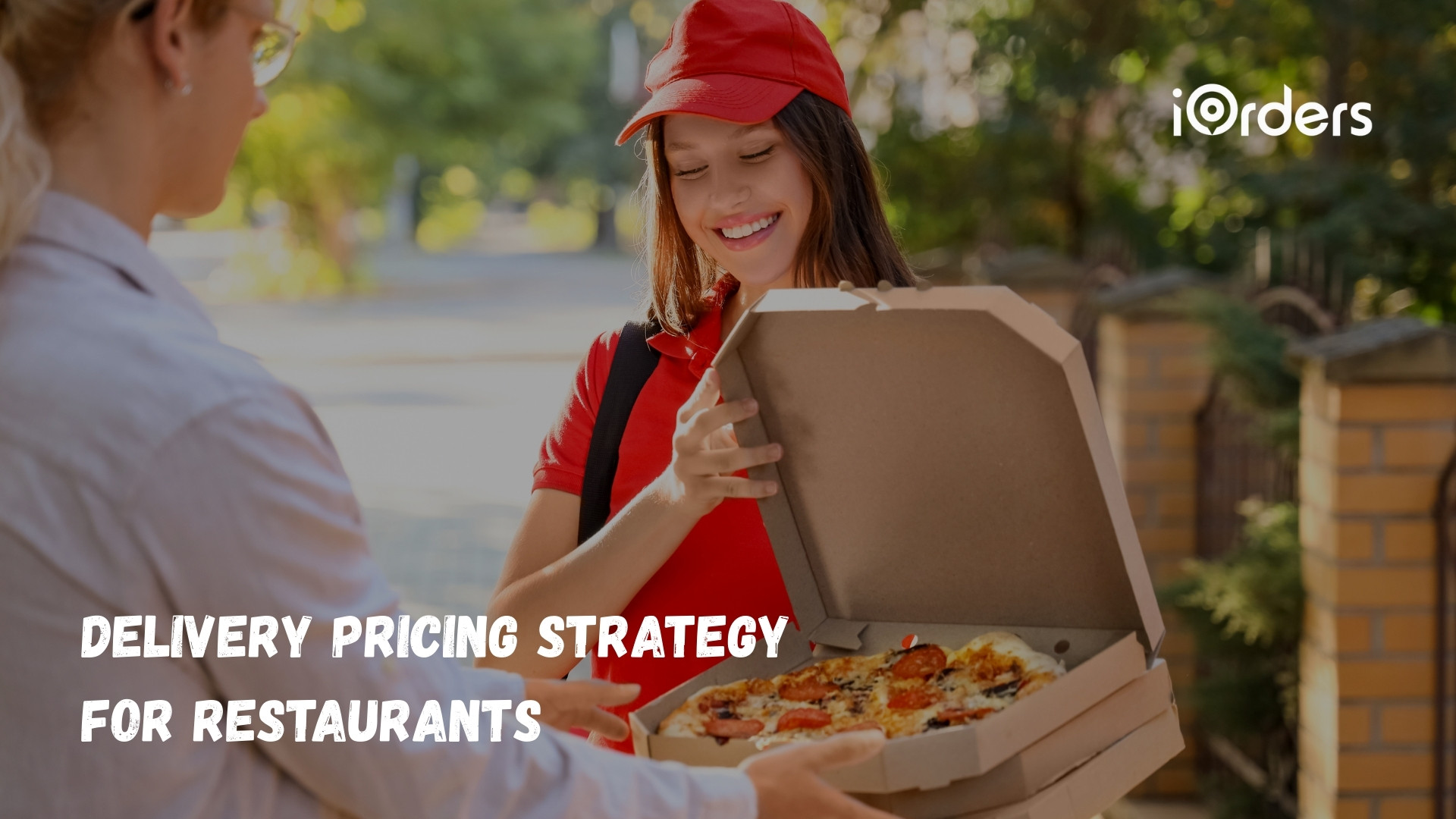
Many restaurant owners face the same problem: delivery volume is increasing, but actual profit is staying flat. When you add up third-party commissions, expensive packaging, and credit card fees, the margin on a typical order can vanish before the bag even leaves the kitchen. Without a clear delivery pricing strategy, your restaurant ends up paying for the customer’s convenience out of your own profit.
Most operators react by raising menu prices randomly, but these quick changes can drive away customers without fixing the core issue. A structured strategy helps you align your fees and menu prices with the real costs of each ordering channel.
In this guide, you will learn practical delivery pricing strategies to help you protect your margins and make every delivery order financially sustainable.
A delivery pricing strategy is how you set delivery fees and menu pricing so every order covers its own costs. It separates restaurants that simply move food from those that actually profit from delivery. Without a clear pricing structure, delivery orders can quietly reduce margins once packaging, labor, and platform fees are applied.
To protect your profit, your strategy should account for five operational pressure points:

When these five factors are balanced correctly, your delivery operation becomes a sustainable revenue stream rather than a constant drain on your dine-in profits.
Delivery can look like a success on paper because of high order volume, but 'busy' does not always mean profitable. Without a strict pricing strategy, commissions, driver costs, and service errors slowly eat away at your bottom line. These costs often remain invisible until they stack up at the end of the month.
The most common profit leaks occur in these areas:
When you lose visibility into these costs and lose your direct connection to the customer, delivery becomes a volume game that is nearly impossible to win.
Before choosing a POS system for your restaurant, review the full breakdown in Square POS Pricing Guide and Hidden Costs in 2025.
Restaurants apply structured delivery pricing models to control margin pressure, manage driver workload, and prevent delivery orders from disrupting dine-in and pickup service during peak periods.
Premium delivery menu pricing raises specific item prices for delivery orders so restaurants absorb platform costs without reducing the in-store menu margin structure.
Why you should do this: Delivery orders require extra packaging, verification steps, and staging space. Adjusted pricing guarantees these additional service layers do not erode dine-in margins.
Example: Only offering easy-to-pack pasta dishes for delivery while keeping complex, plated specials for dine-in guests.
Flat delivery pricing charges the same delivery fee for every order, regardless of order size or distance within a defined delivery radius.
Why you should do this: Predictable pricing simplifies ordering decisions while allowing staff to focus on service flow rather than recalculating delivery charges for each order.
Example: A standard $5 fee for any delivery within 5 kilometers of your front door.
Distance-based delivery pricing increases delivery fees gradually as the order location moves further from the restaurant.
Why you should do this: Distance pricing protects margins on longer deliveries that consume driver time and kitchen staging capacity.
Example: Charging $3 for the immediate neighborhood and $7 for the next town over.
Zone-based pricing divides delivery areas into geographic zones with different delivery charges based on operational distance and service difficulty.
Why you should do this: Geographic zones align delivery fees with actual travel conditions rather than theoretical distance calculations.
Example: A downtown restaurant charges lower fees for the residential side of town and higher fees for the industrial park, where traffic is always heavy.
Minimum order thresholds require a certain order value before delivery becomes available or before delivery fees are reduced.
Why you should do this: Minimum thresholds ensure that each delivery trip contributes meaningful revenue rather than consuming driver and kitchen capacity.
Example: A restaurant requires a $25 minimum for delivery while allowing $10 orders for pickup.
Dual pricing applies different prices depending on the payment method to offset higher credit card processing costs.
Why you should do this: Payment processing costs accumulate across thousands of orders and directly affect restaurant margins.
Example: A restaurant offers a 3% discount for guests who choose to pay with debit or cash on delivery.
Direct ordering incentives encourage customers to place delivery or pickup orders through the restaurant’s own ordering system instead of third-party platforms.
Why you should do this: Direct orders give restaurants control over pricing, customer relationships, and operational data.
Example: A restaurant offers a free drink or 10% off for anyone who orders directly through your branded website.
Systems like commission-free ordering through iOrders help restaurants control pricing, data, and order management from one platform.

A delivery pricing strategy only works if you know the real cost of an order. Use these four simple formulas to see if your delivery business is actually contributing to your bottom line or quietly draining it.
This tells you exactly what is left over for your bank account after everyone else has been paid.
Formula: Delivery Profit = Menu Price – Food Cost – Packaging Cost – Driver Cost – Platform Commission
Example: If a $32 order costs you $12 in food, $2.50 in packaging, $6.50 for the driver, and $7.50 in commission, you only keep $3.50. If that $3.50 doesn't cover your rent and utilities, the order is a loss.
Use this to see the hidden tax you are paying to third-party marketplaces.
Formula: Commission Cost = Order Value × Commission Rate
Example: A $38 order at a 25% commission rate means you are handing over $9.50 per bag. Multiplying that by 100 orders a week shows you the true cost of using external apps.
If you use in-house drivers, this formula helps you see your true hourly efficiency.
Formula: Delivery Labor Cost = Driver Hourly Wage ÷ Deliveries Completed per Hour
Example: A driver earning $22 per hour who only completes 2 deliveries in that hour costs you $11 per order in labor alone, likely making that hour unprofitable.
This is the minimum dollar amount an order must reach before you make a single cent of profit.
Formula: Breakeven Order Value = Total Delivery Costs + Food Cost
Example: If your packaging and delivery fees total $9 and the food costs $12, any order under $21 is actually costing you money to fulfill.
To understand how delivery pricing impacts your overall profitability, review Average Restaurant Profit Per Month: Key Factors and Insights.
Delivery pricing becomes easier to control when orders move through a commission-free system. Instead of losing a percentage of every order to marketplace platforms, restaurants retain full menu revenue and structure delivery fees based on real operational costs.
A commission-free system also allows restaurants to manage delivery operations from one centralized platform rather than juggling disconnected tools.
Several operational improvements appear once delivery runs through a direct ordering system like iOrders.
Across a same-store comparison from month one to month twelve on iOrders, restaurants saw 288% growth in active customers, a 244% increase in monthly orders, a 13% rise in average basket size, and 2× purchase frequency.
A successful delivery pricing strategy turns delivery into a controlled system rather than a daily reaction to platform fees. By applying pricing models that reflect your actual costs, like labor, packaging, and distance, you protect your margins and ensure every order contributes to your bottom line.
Sustainability in delivery requires more than just better math; it requires the right technology. iOrders gives you that control by centralizing your ordering, pricing, and guest data into one commission-free platform. Whether it is direct website ordering or integrated delivery fulfillment, you keep the revenue and the customer relationships that third-party apps usually take.
With a structured strategy and a dedicated platform, delivery becomes a profitable extension of your business rather than a risk to your margins. Book a demo with iOrders today to see how commission-free ordering and direct guest data can protect your profit and scale your delivery operation.
1. How often should restaurants review their delivery pricing strategy?
Restaurants should review delivery pricing every three to six months. Changes in fuel costs, packaging expenses, and platform fees can affect margins over time.
2. Should delivery menu prices always match dine-in prices?
Many restaurants maintain slightly higher prices for delivery items to offset packaging, operational handling, and platform-related costs that do not exist for dine-in orders.
3. What factors influence delivery pricing for restaurants?
Delivery pricing typically depends on food cost, labor, packaging, driver distance, platform fees, and operational overhead required to fulfill off-premise orders.
4. Can restaurants combine multiple delivery pricing strategies?
Yes. Many restaurants combine approaches such as minimum order thresholds, menu price adjustments, and delivery fees to balance profitability and operational efficiency.
5. When should restaurants adjust delivery fees?
Restaurants often adjust delivery pricing when operational costs change, demand increases during peak periods, or delivery zones expand to new neighborhoods.